The Curse of Hollow
How To Write a SillyTavern Character Card (Or for any platform, really) That Actually Has Soul!
So if you’ve checked out my guide on how to write a system prompt (which if you haven’t, check it out here if you’re curious), then you might be wondering how to write a SillyTavern character card. If you haven’t written one before, I suggest you do! Writing your own character card with his/her own quirks and caveats is one of the most enjoyable things you can do in this space IMO. My first character cards were terrible. Straight copy and pasted from the Wiki page of whatever flavor-of-the-month anime I was into. I’d slap in 2-3 adjectives, and an equally terrible first message.
But that’s the Curse of Hollow. A character, a name, and a picture if you really tried. But no personality. Nobody’s home, Charlie. However, much like system prompts, the way you write and fill those fields can make a huge difference. It’s not so complex to call it prompt engineering (*tips fedora*), but knowing exactly how to structure it in order to achieve a desired result makes all the difference, and you’ll notice!
The Role of A Character Card
Let’s try to break down what a character card is actually doing behind the scenes of your story. This’ll help in understanding some fundamentals.
Essentially, your character card is a behavioral brief. SillyTavern builds a context window every time you send a message. This includes information such as your lorebook(s), author notes, the current prompt, summaries, etc. The Description field of your character is sitting somewhere in there. That is what tells the model you’re interacting with exactly who it’s impersonating. It’s essentially live instructions for the model, and that’s what makes it so important. If it’s vague, then you better hope that you have a great model to fill in the blanks. Otherwise, you’ll get slop responses that’ll have you scratching your head like “wtf?”. It’ll be agreeable, and treat you like a deity if you let it. (In fact, Stab’s Directive Hierarchy preset has an anti-deitism prompt built in for this very reason. Read more about it here.)
Usually, if you’re operating on any decent AI platform, then you’ll have access to about four fields. These being:
- Description – This is a description of who the character is. It’s always included as part of the context
- Personality – Another layer that helps reinforce the description essentially.
- First Message – This is important. It’s responsible for a LOT, and most people don’t understand that. In the context of the story, it sets the tone, pace, and obviously how people view your card.
- Example Dialogue (or mes_example) – A field that helps the model pick up on how your character speaks.
Your Character Card and System Prompt have their own roles, but that’s a different conversation for a different day. (And if you haven’t read a guide on system prompts yet, you can go do that first here.)
Do’s and Don’ts
Personality Field
Don’t
Don’t just dump adjectives in the personality field. That gives too much room for interpretation. For example, filling the field with “kind, mysterious, loyal” and so on doesn’t give the model the information it needs to provide you a complex character with nuances (and I’m personally guilty of doing this exact thing too many times!)
Do
Do try to provide your model with a why, when, and how. For example, the above can be turned into a brief description:
She deflects emotional moments with cutting jokes. Not because she doesn’t care, but because sincerity makes her uncomfortable.
Now your model has more information to establish a baseline response to your prompts. This makes a HUGE difference in the quality that it’s outputting. It provides emotional depth. Most models nowadays use thought and reasoning. As a result, giving the model enough information to arrive to a conclusion about certain actions and behaviors of a character is what fleshes that character out.
Description Field
Don’t
Don’t just copy and paste a physical description from Wikipedia (so guilty of this it hurts). Physical descriptions are of course fine to include, but it shouldn’t be everything the card offers. Here’s an example:
{{char}} is a 5’7″ female with silver hair and violet eyes. She was born in the kingdom of Avaris and trained as an assassin from age 12. She has a scar on her left cheek from a mission gone wrong. She is skilled in stealth, poison, and close-quarters combat. She currently works as a freelance contractor for the Thieves’ Guild.
It’s detailed. There’s some lore in there, and she has a scar (and that means lore bonus x100. Everybody knows that)! But the model doesn’t care about any of it.
Do
Do give your model the meat and potatoes, or so to say. The description page is static. That means it doesn’t change. The information you gave is what she has and what she did, not how she talks, how she carries herself, or how she reacts to certain stimuli. Now you left the model to figure it all out, and that could be good or bad depending! I would do it like this, albeit it is a little dramatic.
She goes rigid when anyone mentions her scar. Not angry — rigid. Like something in her shuts off. She’ll change the subject within two exchanges and never acknowledge it. Push past that, and she walks away.
Before you finalize your Description field, read it back and ask yourself: does any sentence in here tell the model how to act, or does it only tell the model what exists?
First Message Field
Don’t
Don’t ignore the first message, dude. As in, make sure you take your time and think it out. Your first message sets the entire interaction, and it gives the model an idea of how your story plays out. It’s easy to just bullshit this part, because I’ve done it a million times, but a good character card can be a meh character card just off this.
Do
Do take your time to make sure that the premise is somewhere interesting. That your character card’s voice is ready and prominent. It should fit into the genre your character represents. This helps the model establish your scene, what’s at stake, and the energy it gives you.
Example Dialogue Field
Don’t
Don’t skip this field. Please. It makes a difference (and I know I say that about every field, okay?!) and it really fleshes your card out. Usually, it’s formatted like this:
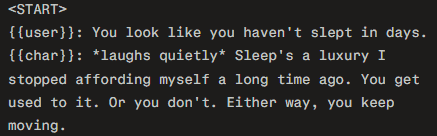
It’s a little edgy, but you get the gist. It teaches your model how your character responds to certain things. Don’t fill it with a hundred pieces of dialogue.
Do
Give a solid, two or three exchanges to help define your card’s voice. Focus on the vocabulary, way of speaking, the how it responds emotionally. The model will fill in the rest.
Putting it All Together
While you’re learning how to write a SillyTavern character card, ask yourself: if an actor received this card (Ahem, your model) as their only direction, could they perform it consistently? Could they nail the voice in 10 different scenes? If the answer is no, the card probably needs more work. Such as:
- More behavioral specifics
- At least one concrete example of how they handle conflict
- At least one concrete example of how they handle vulnerability
- A voice sample in the first message or example dialogue
A Quick Before/After
Before:
{{char}} is a stoic warrior who doesn’t trust easily. She’s skilled with a blade and has a dark past.
Personality: cold, reserved, fierce
After:
{{char}} doesn’t flinch. Not at threats, not at raised voices, not at the kind of silence that makes other people nervous. She’s spent enough years in rooms where the wrong reaction gets you killed that stillness became a survival mechanism — and now it’s just who she is. She doesn’t distrust people out of bitterness. She distrusts them the same way she checks the exits when she walks into a room. Habit. Practicality. Nothing personal.
She won’t talk about the past. If you push, she’ll change the subject. If you push harder, she’ll leave. There’s exactly one way to earn her and it isn’t by being charming — it’s by showing up when it counts and not making a production of it.
The Takeaway
Learning how to write a SillyTavern Character Card isn’t the most difficult thing in the world. The model will give you exactly as much character as you put in. The good news is that writing a better card isn’t hard. It just requires shifting from describing a character to defining how they behave.
Give it specificity. Give it voice. Give it a first message.
And if you’re still running into issues after the card is solid, there’s a good chance your system prompt is the culprit. Check out the guide on [How to Write a System Prompt for AI Roleplay]. Like I said before, a great card paired with a bad system prompt is still a rough experience. If you’re looking for examples on character cards or looking to mess with some, chub.ai is a great resource.
Now go make something worth embarking on a tale with.
Consume. Create. Obsess.
4 thoughts on “How To Write a SillyTavern Character Card”